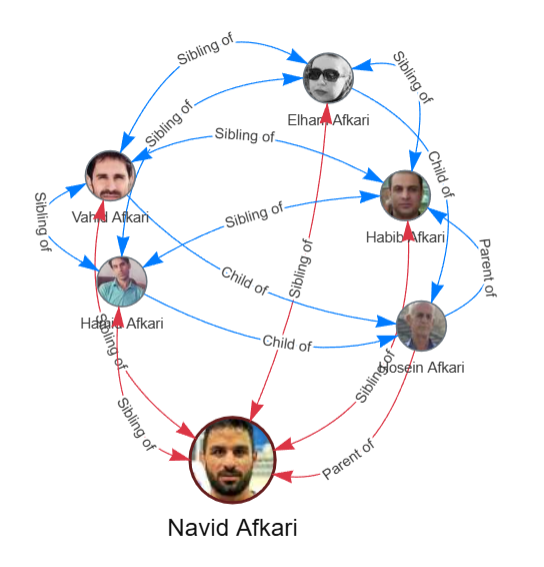
In many human rights cases, individuals are not affected in isolation. Arrests, executions, and killings carried out by government forces often extend beyond a single person and, in many cases, impact both families and the wider community. Understanding the connections between individuals can therefore provide a clearer picture of a case and help uncover its broader dimensions.
On the Witness Report platform, each individual has a dedicated profile where their status and known information are documented. When applicable, the profiles also include relatives or associated individuals, especially if they too have been arrested, executed, or killed by government forces. By documenting these connections, the platform helps place each case within a broader human and social context.
To keep individual profile pages simple and readable, complex relationship graphs are not displayed directly within those profiles. Instead, these connections are stored in the database and presented visually as relationship graphs in the media section of the website.
In these graphs, each individual is represented as a node, and the lines between them indicate the type of relationship, such as parent, sibling, or other relevant connections. These links may relate to one or multiple cases, providing a broader context that is often difficult to grasp through text alone.
This visual approach is particularly valuable in complex cases, for example, when several members of a family are arrested over time, or when multiple individuals connected through a shared case face severe outcomes such as execution or state violence. In such situations, relationship graphs offer a clearer and more structured view of how these cases are interconnected.
Witness Report aims not only to document individuals but also to map and analyse the network of relationships between them. This structured perspective can support researchers, journalists, and human rights advocates in identifying patterns, understanding context, and documenting violations more effectively.